Inside a leather workshop, each hide is mapped and cut with care. Large, usable pieces move forward into finished products, but around the cutting table, narrow strips, corners and irregular offcuts begin to accumulate.
These fragments of material still carry the strength, natural fibres, and resources invested in the original hide. Their small dimensions exclude them from further use within the workshop’s original production process. Even with careful cutting, this valuable leather becomes waste once its first industry has no further use for it. A few containers may hold one workshop’s offcuts, but worldwide, the leather industry generates around two billion kilograms of waste each year.
The scale exposes a central challenge for the circular economy: finding the next use while the material still has value.
When surplus finds its next sector
Industrial symbiosis gives that challenge a practical model.
In practice, industrial symbiosis is a collaboration: surplus material from one sector becomes a manufacturing resource for another, allowing valuable resources to travel between industries and remain in circulation. This exchange preserves more of the energy and natural resources already embedded in a material. It can also reduce demand for newly extracted inputs by giving manufacturers credible alternatives drawn from resources already in circulation.
Its success depends on industries seeing beyond a material’s first purpose. Producers, manufacturers and specifiers each create part of the route that carries it into a new application. The circular economy moves when materials do. With the right cross-industry connection, an overlooked by-product can be reimagined as something designers actively want to specify. That demand keeps its value alive and gives the material somewhere meaningful to go next.
Enter Karta.
Built from materials already in motion
Karta intercepts offcuts collected from leather production across Europe before they are lost to landfill. These fragments are processed into fibres, combined with natural resins and vegetable fats, and pressed into a strong, resilient layer.
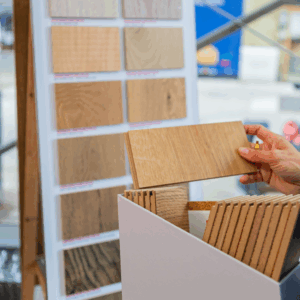
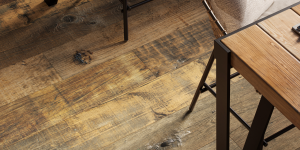
Within our Recycled Leather Series, this material supports impact resistance, durability and stability across demanding commercial interiors. Its next application takes shape inside our five-layer click-system floor, made with zero plastics or petrochemicals.
At the centre of each wide plank or oversized herringbone board, our wood fibre core extends the same thinking. A blend of PEFC-certified recycled wood, sawdust, branches and twigs is compressed into a dense, stable board. From the forest floor to yours, resources left behind by timber processing become the structural heart of the surface.
Leather production and timber processing rarely meet within a conventional supply chain. Inside Karta, their by-products become complementary layers within the same commercial surface. This is material matchmaking in action: separate waste streams working together through one specification.
By connecting these material streams, Karta creates commercial demand for resources already in circulation and gives them a valuable place within the built environment.
Put secondary materials on the plan
Circular systems become stronger when recovered materials are specified for real projects. Architects and designers influence that demand through every floor plan, finish schedule, and material library.
Every square metre matters. Specifying secondary materials across a workplace, hotel, restaurant, retail environment or residential development builds demand at meaningful scale. That momentum keeps recovered resources moving and gives new material connections room to grow. At commercial scale, specification becomes a clear market signal, giving manufacturers confidence that recovered resources have a place in future projects and strengthens the case for investing in their collection and processing. What goes onto the floor plan can change the future of a material. Specification gives overlooked by-products lasting commercial value and a route into the next generation of surfaces.
This influence begins long before installation. Every material selected helps shape what manufacturers make next and which overlooked resources they are prepared to bring back into use.
The future is hiding in plain sight
Cross-industry thinking holds one of the most significant opportunities for sustainable surface innovation. It widens the material search to include resources already being produced, collected and overlooked.
Inside Karta, leather offcuts sit alongside sawdust, branches, twigs and recycled wood resources, each contributing to a commercial surface with a valuable future. The next breakthrough may already be sitting beside a cutting table, beneath a workshop saw or within an established recycling stream. Finding it requires curiosity across industries and commercial demand for whatever it becomes.
Become a material matchmaker
What other materials are waiting at the edge of a production line for the right introduction?
Karta is already putting that question into practice. Our Recycled Leather Series demonstrates what can happen when industries exchange valuable by-products and designers give those materials somewhere meaningful to go next.
Explore Karta’s plastic-free flooring for commercial interiors, or speak to our team about specifying a low-emission, future-ready alternative to vinyl and LVT. Get in touch with our sustainable flooring experts today.