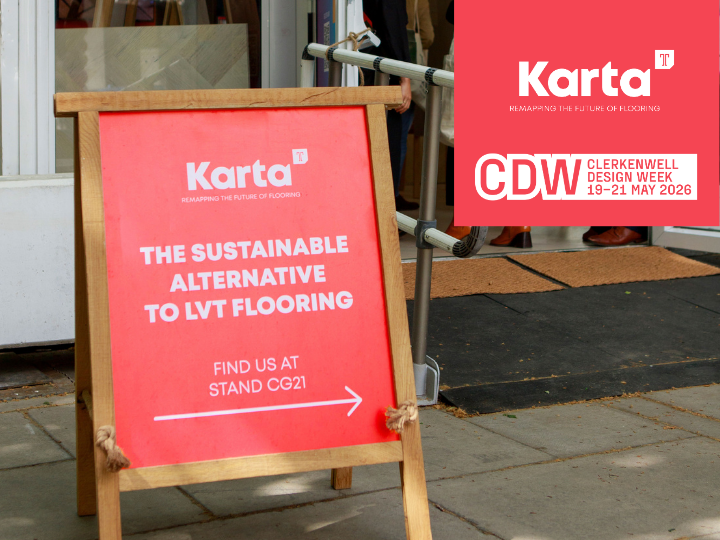
Three days, hundreds of conversations, and one shared belief that the future of flooring can be better.
We’d like to extend a sincere thank you to everyone who visited the Karta stand during Clerkenwell Design Week 2026. Whether you stopped by for five minutes or spent half an hour exploring the details beneath the surface, your enthusiasm, curiosity, and challenging questions helped make this our most rewarding event yet.
And if you couldn’t join us this year, here’s what you missed…
Rain on the Streets, Energy on the Stand
The week may have begun beneath grey skies and persistent rain, but that certainly didn’t keep the design community away.
From the moment the doors opened, architects, designers, specifiers, developers, and sustainability professionals arrived with a genuine appetite to learn more about what flooring can become.
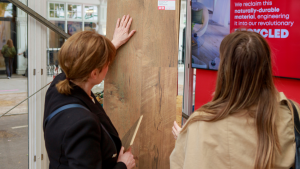
Throughout the event, our stand became the place for conversations around material responsibility. You wanted to understand the materials, the construction, the environmental impact, and the thinking behind every design decision.
That level of engagement reflects a wider shift taking place across the commercial interiors sector. Material transparency is becoming increasingly important. Designers are looking beyond aesthetics and asking deeper questions about what products are made from, where materials come from, and what happens when their useful life eventually comes to an end.
Those are exactly the conversations we came to Clerkenwell Design Week to have.
Bring the Challenge
One of the most encouraging aspects of the week was the level of scrutiny visitors brought with them.
Sustainability claims are everywhere. The design industry has become rightly cautious about marketing language that sounds impressive but lacks substance. Many visitors arrived with a healthy degree of scepticism, and we welcomed it.
Questions came one after the other:
- How is Karta different from conventional resilient flooring?
- What materials sit beneath the surface?
- How durable is a floor made from natural and reclaimed materials?
- Can commercial performance really be achieved without plastics?
- What happens to these materials at the end of their life?
These are important questions, and they deserve detailed answers.
At Karta, we don’t shy away from difficult conversations because our construction has been designed specifically to address them. Visitors explored our five-layer system, combining cork, PEFC-certified wood fibre, recycled leather, biodegradable inks, and our AC5-rated Karta Plated® surface technology. Together, these layers deliver commercial-grade performance without relying on plastics or petrochemicals.
Many were particularly interested in the recycled leather layer, created using reclaimed leather fibres diverted from European waste streams that would otherwise be destined for landfill. Others were fascinated by the wood fibre core, manufactured from responsibly sourced and recycled timber materials.
These discussions reinforced something we’ve believed since the beginning: sustainability becomes more powerful when it is transparent.
Get the full story on what makes up our Recycled Leather Series here.
The Wait Is Over: New Herringbone Format
Of course, there was one question we heard repeatedly throughout the week.
“What’s next for Karta?”
After months of anticipation, Clerkenwell Design Week 2026 became the moment we unveiled our bold new format.
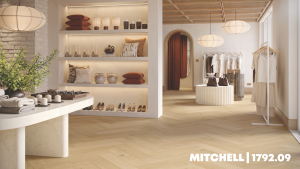
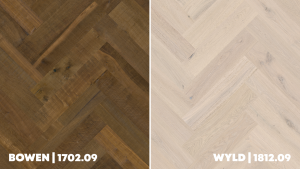
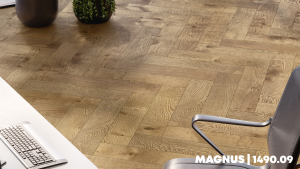
Our new oversized herringbone format marks the next chapter in the evolution of the Recycled Leather Series. Developed in response to growing demand from architects and designers, the format reimagines a familiar pattern at a much larger scale, creating stronger visual impact and greater architectural presence across commercial interiors. Four floors across the broad tonal spectrum of our Recycled Leather Series, all dutiful, true-to-life replications of real timber from the Ted Todd and Woodworks by Ted Todd archives.
Each 200mm x 900mm block introduces a striking interpretation of herringbone while retaining the same construction, durability, and environmental credentials that underpin the wider collection. The format also works seamlessly alongside existing Recycled Leather Series planks, opening opportunities for zoning, transitions, feature areas, and more creative layouts.
And more to our wide plank format, which boasts no repeats in over 20 boards (more than double the current industry standard of 6-10), our oversized herringbone goes above and beyond with no repeats in over 40 boards.
The response exceeded our expectations.
Visitors immediately began discussing applications across workplace environments, hospitality projects, retail destinations, and public spaces. The scale of the format creates a different experience entirely. It feels confident, architectural, and unmistakably designed for ambitious, future-ready spaces.
Most importantly, it demonstrates that sustainable flooring no longer needs to limit creative ambition.
Looking Beyond the Surface
While the oversized herringbone generated plenty of attention, the conversations beneath the surface were equally significant.
Across all three days, we witnessed growing interest in how our floors are made rather than simply how they look.
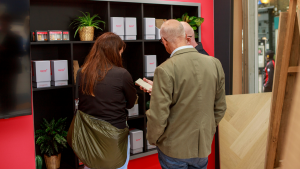
Visitors wanted to understand why Karta uses cork backing. They wanted to explore the benefits of wood fibre construction. They were intrigued by the story behind our recycled leather layer and the role it plays within the floor’s overall performance. They asked about indoor air quality, circular design principles, and material recovery.
The flooring industry is changing.
For many years, performance and sustainability were often treated as competing priorities. Today’s design community increasingly – and rightly – expects both.
Karta was developed around that expectation. By combining natural, renewable, and reclaimed materials with advanced manufacturing techniques, we believe flooring can support ambitious commercial design while reducing reliance on plastic.
The Future of Flooring
If there was one theme that defined this year’s event, it was momentum.
Momentum towards more responsible material choices, towards greater transparency, towards circular design principles, and towards products that perform without asking the planet to absorb the hidden cost.
The future of flooring will be shaped by architects, designers, specifiers, manufacturers, and clients willing to ask difficult questions and demand better answers.
That future requires a fundamental rethink of the materials we use, the waste we create, and the systems we rely upon.
Karta exists because we believe that rethink is already underway. You deserve to ask more from the materials you specify; we’re here to deliver.
Until Next Year
To everyone who visited our stand, thank you for your time, your curiosity, your challenges, and your willingness to engage in meaningful conversations about the future of our industry.
If you couldn’t make it to Clerkenwell Design Week this year, we’d love to introduce you to our new developments personally. Our team remains available to discuss upcoming projects, provide samples, arrange presentations, and explore how Karta can support your sustainability goals.
The event may be over, but the work continues.
Together, we can help keep valuable materials in circulation, reduce dependence on plastic-based flooring systems, and create spaces that perform beautifully for people and the planet alike.
We’ll see you at Clerkenwell Design Week 2027. Until then, let’s keep rewriting the future of flooring.